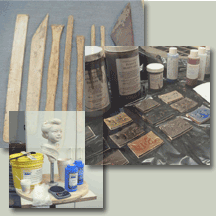
Modeling
tips
WED
Clay: I recently discovered this modeling clay from Laguna
Clay company that is used by many special effects movie
studios. Official name: EM-217. This is an incredibly
smooth and creamy water based clay that also contains
retardants that slow the drying time considerably and
prevent the shrinking and cracking problems that are
so common with regular water based clays. The WED clay
should never be fired and is an excellent and cost effective
(about $13 for a 50 pound box) product for large sculpture
instead of using regular ceramic or plasteline clays.
Since the piece will not be fired, complex armatures
can be used inside and since this is mostly water based,
it will stiffen slightly, giving the piece added support.
The clay can be sealed while still wet with Krylon Crystal
Clear plus an additional coat of Krylon Matte Clear to
dull the shine. Once sealed, the piece can be easily
molded without problems of condensation (this is best
done in temperatures below 75 degrees to assure there
is no sweating of the clay while molding).
-
Wax
Positives: If you want to make a one of a kind small
bronze without having to make a mold, you can make the
original in a medium -soft wax and give that to the foundry
for casting. The drawback is that they only have one
shot at getting it right. If the first casting does not
come out well, there is no mold to make another wax positive.
-
To
initially dry out a ceramic piece naturally and evenly,
put it in a plastic garbage bag (tied very loosely) and
place it in direct sunlight (one advantage of living
in Arizona - no shortage of sunlight). Don't do this
without the bag or the piece will crack.
-
To
achieve a smooth surface, if desired, apply sparingly
with a brush the following: water based clays - water,
oil based clays - mineral spirits, polymer clays - lighter
fluid. After water based clay is fired or polymer clay
is baked, you can further smooth and polish the surface
with fine sandpaper and steel wool.
-
To
get a baby smooth surface on a water based clay (especially
if you are using a clay with a high grog content), when
nearly finished, paint the piece with layers of slip, then
add your final surface detailing.
-
When
you think you've finished modeling a piece (or at any
time in the process), look at it in a mirror. You will
be surprised at what you did not see beforehand.
-
With
figure sculpture, always make heads and hands detachable
so you can work on them apart from the main figure. Heads
and hands usually require much more detail and should
be freely rotated while modeling them to observe all
angles.
-
Children's
heads are nearly as big as adult heads. It's their bodies
that are proportionally so much smaller. Don't make the
mistake of making an adult figure with a child that has
a doll head.
-
Eyes
are NOT flat! Remember, there are actual balls in those
sockets.
Armature
tips
-
Be
sure your armature is strong enough to support the amount
of clay that you will be adding when working with plasteline
clay. Nothing worse than having a piece bend and slump
half way through the project.
-
If
possible, build an armature with detachable head and
hands. Pipes that screw or pin together is one suggestion.
Wires can be clamped.
-
One
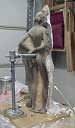
way to make a large or life-size armature - basic overview:
-
First,
plan the structure of the armature and draw a detailed
illustration of how the armature needs to be constructed
inside of your figure, depending on the pose.
-
Start
with a large board that is mounted on a platform
with wheels or dollies.
-
Build
the core out of galvanized pipe running through the
main sections of the sculpture, using T's and elbows
for making turns. An additional section may need
to be attached on the back to support the main frame.
These pipes are screwed to the board using flanges.
-
Use
heavy gauge aluminum wire through T's in appropriate
places to add extremities and bend them in place.
-
Cut
pieces of Styrofoam to fill the large voids of the
sculpture and duct tape them to the figure's
pipe armature. You can use rasps to shape the Styrofoam.
-
Cover
the entire figure section with aluminum foil to hold
the Styrofoam and keep the little balls from coming
off everywhere, making a mess.
-
Wrap
the entire armature in a spiral manner with thin,
twisted wire. This gives the clay something to hold
on to.
-
Cover
the armature with a thin layer of plasteline clay.
This is easier if the clay has been warmed in a light
box or microwave. You now have a fairly light, yet
strong armature with which you can continue to build
out your piece in clay.
Moldmaking
tips
-
Using
Plaster: Plaster and hydrocal are good materials for
making decent and inexpensive mother molds. Though heavier
than the more expensive resin and fiberglass products
such as Smooth-on "Plasti-Paste", they can
be reinforced with strips of burlap dipped in a runny
mixture of plaster and water. To apply the plaster (or
hydrocal), put several quarts of plaster in a bowl and
quickly mix in enough water (with a gloved hand) until
the plaster is the consistency of cake frosting. Stir
well and squeeze any lumps with your hand. Immediately
use a spatula to spread the plaster over your rubber
mold (which has been sprayed with a mold release if you
have not used silicone rubber). You will have about 15-20
minutes of working time before the plaster is too stiff
to work.
-
Dishwashing
liquid (Dawn, Joy, etc.) works well as a barrier for
separating silicone molds where the sections of the rubber
meet. Just brush it on undiluted where you want the rubber
to separate, let it dry, then paint on fresh rubber for
the next section.
-
Large
pieces need to have a thicker rubber mold made (at least
1/2 inch thick) than you would make for a smaller mold
- otherwise, the rubber will be floppy in the mold and
your resulting casting will come out distorted.
-
You
can bolt the sections of your mother mold together to
be sure they are secure and don't shift while casting.
Just make the edges fairly thick and when dry, drill
holes through both edges of the mold. When you put the
mold together for casting, line up the holes and run
bolts through, securing them tightly at both ends. Bolts
can be used in place of, or in addition to tire tube
straps or clothesline cord wrapped around the entire
mold.
-
Polytek's
Polygel 40/50 is an excellent urethane rubber to use
for mold making. It is easy to apply, doesn't need a
thickener, mixes in a 1-1 ratio by volume, and is less
expensive than silicone rubber. Be SURE to use a liberal
amount of the proper mold release (Pol-Ease 2300) and
brush it around to every nook and cranny when casting
polyurethanes or the mold and casting will fuse. Learned
that lesson the hard way - not a pretty picture. To apply,
brush on Polygel 40 for the first two coats, mix the
40 and 50 to use for the third coat, and use Polygel
50 for the fourth coat. Don't apply the 50 to the 40
layer without the mixed layer in between.
-
You
can mix Poly-Fiber II with your outer layers of urethane
rubber to strengthen and thicken/stiffen the outer portion.
This also allows you to build up undercuts quickly without
the rubber running off. You can also use Cab-O-Sil, but
Poly-Fiber is recommended since it will make the
rubber stronger where the Cab-O-Sil makes it slightly
weaker. Either fiber material can also be mixed into
polyurethane resins for lay up casting.
-
To
fill out undercuts, embed pieces of dry, squishy sponge
between the layers of rubber to build out the areas.
This leaves the undercut areas flexible while still providing
support for the mothermold.
-
Always
wear rubber gloves and long sleeve (grungy) shirts in
well ventilated areas. Respirators are advisable. Moldmaking
and casting are messy processes and most of the materials
used are skin and lung irritants.
Casting
tips
-
Forton
MG: Forton is an architectural casting medium that is
gaining in popularity among artists. This is a gypsum
and resin material that is many times stronger and much
lighter than plaster. Filler materials (such as bronze
powder) can be added to the top coat to make very nice
cold cast pieces which will take cold patinas just like
real bronze. A thin layer of Forton reinforced with glass
fibers is slush cast in the interior to make a hollow
piece. You can read more about Forton at http://www.artmolds.com/gateway/technique/forton_1.htm I
buy the big sculptors kit at Ball
Consulting. Aluminum sulfate is used as an accelerator
for the slush-cast layer and is usually available where
you purchase a Forton kit.
-
Polytek's
Easyflow 60 is an easy to use 2-part polyurethane resin
that mixes 1-1 by volume. Various fillers can be added
(metal powders, porcelain powder, marble dust, etc) to
create a variety of castings. The Easyflow 60 is white
after the chemical reaction occurs ( does not yellow)
and they also have a clear version available. The material
can be filed, sanded, and drilled after casting.
-
MagicSculp
can be ordered in a variety of colors from sculpt.com.
This is a two part resin putty that when kneaded together,
invoke a chemical reaction that will turn the stuff hard
as rock in about an hour. Until then, you have time to
model the putty as needed so only mix what you can model
in that amount of time. When you first mix it, it is
sticky, so wait about 10 or 15 minutes before you use
it. This material bonds with resin and other castings
and can be smoothed and cleaned up with plain water.
It is ideal for doing repair on castings of any type.
It can be painted, tooled, and sanded once it has cured.
Patina
tips
-
If
you are making bonded metal sculpture and plan to apply
a reactive patina to the metal, silicone mold releases
will interfere with that reaction. Solutions are to either
use a silicone mold that requires no release, or thoroughly
wash your castings to remove all silicone spray residue
before applying the patina. Another option is to dust
the inside of the mold (after applying the silicone spray)
with aluminum trihydrate and the piece will be "paint" ready
right out of the mold.
-
Always
wear rubber gloves and long sleeve (grungy) shirts in
well ventilated areas. Respirators are advisable. Most
of the materials used for patination are irritating to
the skin and lungs.
-
If
you use colored waxes, keep them air tight or they will
dry out. If you have some that have dried out, buy some
clear wax and mix one or more of the colored dried waxes
as needed. You can buy an 8oz jar of white wax and mix
just a tad of the dried (or fresh) color waxes with blobs
of the white to create a variety of lighter colors which
are perfect for stippling on bronze or bonded bronze.
Photography and Presentation tips
-
Do
not photograph your artwork against a distracting background
or a wrinkly sheet. For the best results, invest in a
paper roll. These are simple and fairly inexpensive and
paper rolls can be ordered in a variety of colors. One
suggestion to purchase a paper system is from B&H
photo.
-
When
using a paper roll on a table, be sure to lay the paper
flat on the table and set the support stands back far
enough that the paper does not angle up to the roll directly
behind the piece you are photographing. If the paper
angles sharply up instead of back and then up, you will
have distracting shadows behind your piece.
-
Whether
you are now, or hope to become a professional artist,
and desire a web presence if you don't already have one,
hire a professional to make or redesign your website.
If you lack the know-how to make a quality site and end
up producing one that is poorly designed (e.g, impossible
to navigate, full of broken links and missing images,
blinding and inconsistent color schemes, annoying flashing
graphics or sounds, etc.) - or go with an amateurish
site from a free website provider, that will only detract
from your work (no matter how good it is) and will turn
people off. They will judge your work based on the quality
of your website and exit just as fast as they possibly
can - that is not your goal. Providing an easy to navigate,
informative, and visually pleasing website will make
you appear more capable and professional and may keep
people there long enough to consider buying what you
are offering. If interested (shameless plug), I do offer webdesign service.
|